
When the Rain Finally Comes: Why Dry Soil Makes That First Storm Riskier
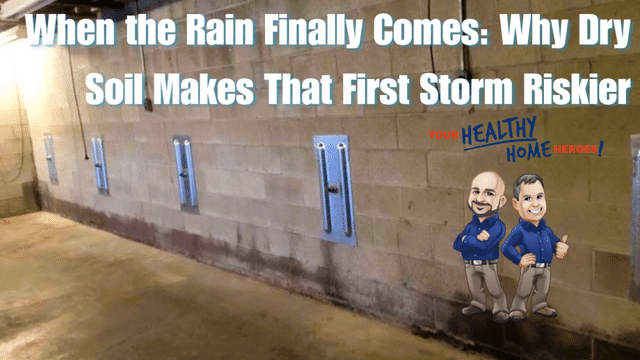
After weeks of heat with little rainfall, the ground around most Tri-State homes is hard, compacted, and cracked. It looks like it could use a good soaking. But when that first significant rain arrives, very dry soil does not absorb water the way homeowners expect.
At Healthy Spaces, we help homeowners understand what happens when heavy rain meets hardened ground and why the transition out of a dry spell can be harder on a home than the dry spell itself.
Why Hard Ground Doesn't Absorb Water Well
Soil that has dried out and compacted can shed water rather than take it in, at least initially. The surface becomes less permeable, and rainfall runs across it instead of soaking down evenly. Hydrologists describe this as reduced infiltration capacity, and it is why a hard summer downpour on dry ground can produce runoff almost immediately.
Those shrinkage cracks that formed during the dry weeks make it more complicated. Rather than absorbing gradually across the yard, water can travel down through the cracks and reach the soil directly alongside the foundation, concentrating moisture exactly where you least want it.
What That Can Mean for a Home
- Water collecting close to the foundation instead of draining away
- Rapid re-saturation of soil that had pulled back from the wall
- Renewed pressure against foundation walls as clay soil expands again
- Water finding its way into the basement at the wall-floor joint
- Sudden demand on a sump pump that has been idle for weeks
- Pooling near downspouts and low spots in the yard
- Erosion around foundation plantings and mulch beds
The Swing Is What Stresses a Foundation
A foundation can handle consistent conditions reasonably well. What tends to cause problems is the swing — soil contracting away during a dry stretch, then expanding back with force when the rain returns.
This is why some homeowners notice a wet basement or a new crack shortly after the first heavy rain following a drought, and assume the storm caused it. More often, the dry weeks set the conditions and the rain revealed them. The water did not create the gap alongside the foundation; it simply found it.
How Interior Drainage Handles the Water That Gets Through
Managing surface water helps, but in our region most basements need a path for the water that reaches the foundation regardless. That is the role of an interior drainage system.
Healthy Spaces installs the WaterGuard system, a below-slab drainage channel set at the wall-floor joint. Water entering at that seam — the most common entry point in a basement — is collected in the channel rather than reaching the floor. The system is backfilled with clean gravel so it stays free-flowing, and collected water is routed to a sump system and discharged away from the home.
For homes where groundwater volume is significant, that sump system matters as much as the drainage itself. A properly sized pump with a reliable discharge line is what keeps a system working during the heavy rain events that follow a dry stretch.
Grading: The Part Homeowners Control Most
Of everything affecting how water behaves around a foundation, the slope of the ground is the factor homeowners have the most direct influence over — and the one most often overlooked after a dry summer.
Soil settles over time. Mulch beds get topped off year after year until they sit higher than the surrounding grade. Landscaping edging traps water instead of directing it. Any of these can leave a home with ground that slopes toward the foundation rather than away from it.
The general guideline is a fall of roughly six inches over the first ten feet out from the house. That is enough to move surface water away before it has a chance to soak down alongside the wall. After a dry stretch, it is worth walking the perimeter and looking at where water would actually go in a downpour.
What Homeowners Can Do Before the Rain Returns
Test your sump pump now. A pump that has not run in weeks is worth checking before it is needed. Pour a bucket of water into the pit and confirm it cycles on, moves water, and shuts off properly.
Check the discharge line. Make sure the line is clear, intact, and carrying water well away from the foundation rather than back toward it.
Clear your gutters and downspouts. Late-summer debris can send roof runoff straight down beside the foundation at the worst possible moment.
Extend downspout discharge. Moving water several feet away from the house matters more when the ground cannot absorb it quickly.
Look for low spots and shrinkage cracks. Gaps in the soil near the foundation can channel water directly downward. Filling significant cracks with soil before heavy rain can help.
Consider a battery backup. Heavy storms and power outages often arrive together. A backup pump keeps the system working when the primary loses power.
Address known basement leaks before the wet season. A leak that was manageable in August is often worse after the first sustained rain.
Healthy Foundation, Healthy Home
The end of a dry stretch is a good moment to make sure water has somewhere to go. Checking drainage, clearing gutters, and testing a sump pump take very little time and can prevent the kind of problems that show up with the first heavy storm.
If your basement has taken on water before, or you are not confident your drainage and sump system are ready, having it evaluated now is considerably easier than dealing with it mid-storm.