
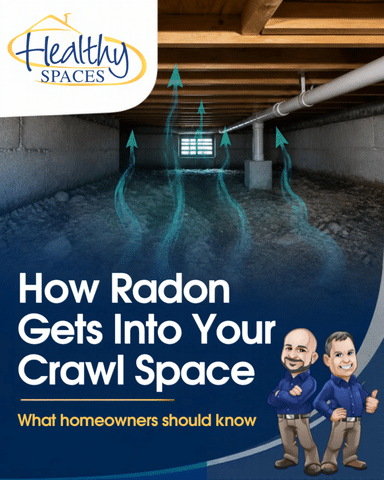
How Radon Gets Into Your Crawl Space
Three Things Determine Whether You Have a Radon Problem
Radon entry isn't random. According to building science, three factors determine how much radon ends up inside a home:
- How much radon is in the soil beneath and around the home
- How easily that radon can find a path inside — cracks, gaps, exposed soil, sump pits, and utility penetrations
- How much the home's air is exchanged and diluted through ventilation
Every home sits on soil that releases some level of radon. What changes the outcome is how many open pathways your foundation gives that gas to travel through — and that's exactly where crawl spaces become a bigger concern.
Why Crawl Spaces Are High-Risk
A traditional, unsealed crawl space is essentially a large opening between your living space and the soil radon comes from. Bare dirt floors, foundation vents, gaps around pipes and utility lines, and unsealed access doors all give soil gas an easy route upward — and once it's in the crawl space, it doesn't stay there. Air pressure differences pull that air up into the rooms above through floor joists, gaps, and HVAC returns, a phenomenon sometimes called the "stack effect."
That's why homes with crawl spaces are considered high-risk for radon issues: the crawl space itself acts like a holding chamber for soil gas, sitting directly beneath the floors your family walks on every day.
Signs You Might Have a Radon Problem
Here's the honest answer: there usually aren't any. Radon doesn't cause headaches, doesn't smell musty, and doesn't leave stains the way moisture or mold does. The only reliable sign is a test result — which is exactly why the EPA recommends every home be tested, regardless of age, foundation type, or whether neighboring homes have tested high or low.
That said, a few crawl space conditions are worth flagging to your inspector, since they tend to go hand-in-hand with easier radon entry paths:
- An open dirt floor with no vapor barrier
- Visible gaps or cracks around the foundation walls or slab
- An open sump pit or drainage system
- Foundation vents that stay open year-round
Testing Is the Only Way to Know for Sure
If your home has a crawl space — or you've simply never had one tested — a radon test is the fastest way to move from "I don't know" to "I have a number." Healthy Spaces Systems completes radon testing in as little as two days, so you're not left waiting weeks for an answer.
Frequently Asked Questions
Do all homes with crawl spaces have a radon problem?
No — having a crawl space raises the risk, but it doesn't guarantee elevated radon. It comes down to how much radon is in your specific soil and how many open pathways your crawl space gives it. Testing is what turns "higher risk" into an actual answer for your home.
Can I test for radon myself, or do I need a professional?
DIY test kits exist, but placement, timing, and lab handling all affect accuracy — and professional testing (like Healthy Spaces' two-day inspection) is done to the standards the EPA, Indiana, and the National Radon Proficiency Program recommend, so you can trust the number you get.
Is radon worse in a crawl space than a basement?
Both sit close to the soil radon comes from, but an open, unsealed crawl space with a dirt floor typically has more exposed surface area and more gaps (vents, access doors, utility penetrations) than a poured basement — which is why crawl space homes are flagged as higher-risk.
I already have a vapor barrier in my crawl space — does that stop radon?
A standard vapor barrier is designed to manage moisture, not radon, and on its own it usually isn't sealed or connected to a venting system the way a radon-specific vapor barrier (used in sub-membrane depressurization) is. The only way to know if your current setup is enough is to test.