
What to Do in the First Two Days After Water Damage
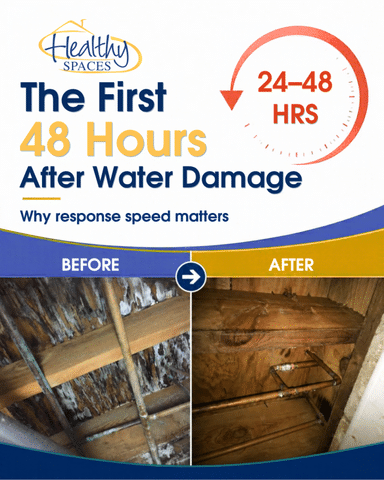
A supply line lets go behind the washing machine. A water heater gives out. A storm pushes water into the basement overnight. Most homeowners handle the obvious part quickly — shut off the water, pull up what is soaked, run a fan.
At Healthy Spaces, we help homeowners understand what happens in the two days after that, and why the window is shorter than most people expect.
What Mold Actually Needs to Get Started
Mold requires three things, and it is worth looking at each one honestly.
The first is a temperature above 40 degrees. Inside a home, that is nearly always true. The second is organic material to feed on, and a house is built almost entirely out of it — wood framing, subflooring, drywall and its paper backing, carpet, and insulation.
That leaves moisture as the only variable a homeowner actually controls. It is also the one that shows up all at once when something leaks.
Mold also prefers conditions that describe the parts of a house nobody visits: no sunlight, limited airflow, and little disturbance. A wall cavity, the underside of a subfloor, the space behind a baseboard.
Why the First Two Days Matter So Much
The distinction that matters here is between a water problem and a mold problem. In the first 24 to 48 hours, most water events are still just water problems. They are unpleasant and they take work, but they are contained.
Past that window, the situation can change in kind rather than degree. Once growth begins on a material, the question is no longer how to dry something — it becomes how to remove what has grown, what it has grown into, and how far it spread while nobody was looking.
That is why response speed tends to matter more than the size of the original leak. A modest amount of water that sits for a week can create a larger problem than a dramatic amount that is handled properly in a day.
Where Water Damage Usually Starts
The events we are most often called about after the fact:
- Washing machine supply lines and dishwasher connections
- Water heaters, particularly ones past their expected service life
- Burst or frozen pipes, including lines running through unconditioned spaces
- Toilet and sink supply lines, and slow drips under vanities
- Refrigerator ice maker lines
- Roof leaks that travel along framing before appearing anywhere visible
- Basement seepage after heavy rain or rapid snowmelt
- Sump pump failures, especially during storms that also cut power
What to Do in the First 48 Hours
Stop the water first. Shut off the supply at the fixture or at the main. Nothing else matters until the source is stopped.
Move what you can. Furniture, boxes, and anything stored on the floor. Items in contact with wet materials absorb moisture and slow drying.
Get air moving and humidity down. Fans and a dehumidifier do more than fans alone. The goal is to lower the moisture in the air, not just across the surface.
Pull up soaked porous materials. Carpet padding, in particular, holds water against the subfloor long after the carpet above it feels dry to the touch.
Check where water traveled, not just where it landed. Water runs along framing and pipes and collects somewhere lower. The puddle you can see is frequently not the wettest spot.
Look underneath. If the home has a crawl space or basement below the affected area, check it. Water finds its way down, and that is where it tends to sit.
Photograph everything. Useful for insurance, and useful for anyone assessing the situation later.
Don't close it back up too soon. Replacing drywall or laying flooring over material that is still damp seals moisture in, and that is a very reliable way to create a problem you cannot see.
What It Looks Like When It Goes Unnoticed
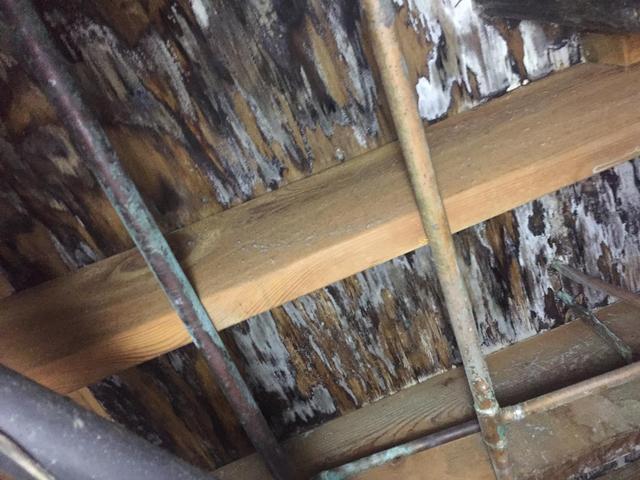
Not every leak announces itself. In one Evansville home, the source was a small drip from a washing machine supply line. It traveled along the pipe inside the wall, and because it was never visible in the living space, nobody knew it was happening.
It is estimated the leak had been going on for at least nine months before anything surfaced. By the time it was found, the drywall collapsed at a touch, and the carpet, padding, subfloor, and pipes in the surrounding area were affected. The damage was finally discovered because a Design Specialist looked in the crawl space.
That project is the argument for checking below after any water event, and for paying attention to a musty smell that does not have an obvious explanation.
Why Drying Out Is Not the Same as Remediating
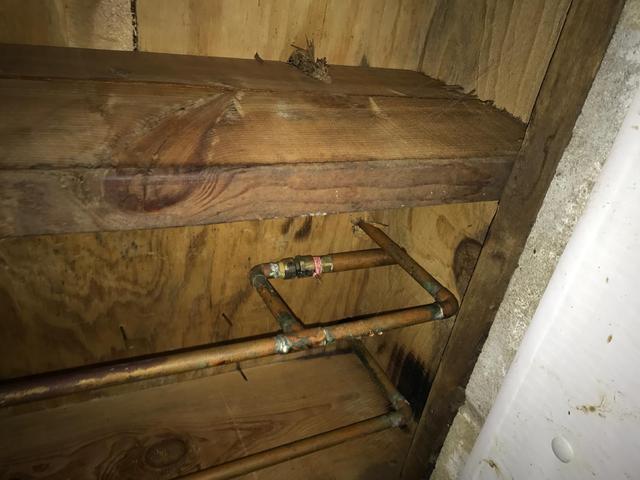
If a space is dried thoroughly within that first window, there may be nothing further to do. That is the best outcome and it happens regularly.
When growth has already started, drying alone leaves the material behind. Professional remediation follows a defined sequence for a reason: identify how far the damage extends, contain the area and remove affected materials, treat the remaining surfaces, and then restore the space — with the water or humidity issue corrected before anything is replaced.
That last step is the one that determines whether the problem returns. Replacing drywall and insulation in a space that is still taking on moisture simply restarts the same process.
Signs the Window Has Already Passed
- A musty or earthy odor that lingers after the area appears dry
- Staining, discoloration, or warping on walls, trim, or flooring
- Drywall that feels soft or gives under light pressure
- Visible growth on framing, subflooring, or the back of baseboards
- Allergy-like symptoms that are noticeably worse at home
- Humidity in the space that stays high despite running a dehumidifier
Healthy Home, Healthy Family
Water damage is stressful, and the instinct to clean it up quickly is the right one. The part worth remembering is that the clock starts immediately, and that what happens in the first two days often determines whether this stays a cleanup or becomes a remediation.
If you have had water in your home recently, or you are noticing a smell you cannot place in a space that got wet a while back, an inspection can identify what is actually there and whether anything is still feeding it.