
Four Ways to Waterproof a Basement - and How to Tell Which One You Actually Need
When a homeowner starts researching how to fix a wet basement, they usually find four different approaches recommended by four different companies — often at four very different prices. It is difficult to tell which one is right when each is presented as the obvious answer.
At Healthy Spaces, we have been fixing wet basements in Tri-State neighborhoods since 1999. Here is an honest look at each method, including the ones we generally do not recommend and why.
First, Why Basements Leak at All
Basement water problems are as old as the structures themselves. Water will enter through any opening it can find — walls, floors, and the joints between them. It can even pass through the concrete itself, which is one reason basements are notoriously damp, humid spaces even when no water is visible.
That matters for choosing a method, because the goal is not simply to block water at one spot. It is to give water somewhere to go before it reaches the inside of your home.
Method One: Exterior Excavation
Heavy equipment is brought in to dig out the entire perimeter of the basement down to the footing. New drain lines are installed, and a waterproof coating is sometimes applied to the outside of the foundation walls.
It is a legitimate approach, and it addresses water before it reaches the wall. The drawbacks are practical ones:
- It is the most expensive of the four methods
- Excavation frequently damages lawns, landscaping, and garden areas
- Decks, patios, and walkways may have to be removed to reach the foundation
- Exterior drains are prone to clogging with silt and tree roots over time
- Once buried, an exterior system is difficult and costly to service
For most Tri-State homes, the disruption and long-term maintenance concerns outweigh the benefit.
Method Two: Interior Subfloor Drain
This is the method we install most often, and the one homeowners often hear referred to as a French drain or drain tile.
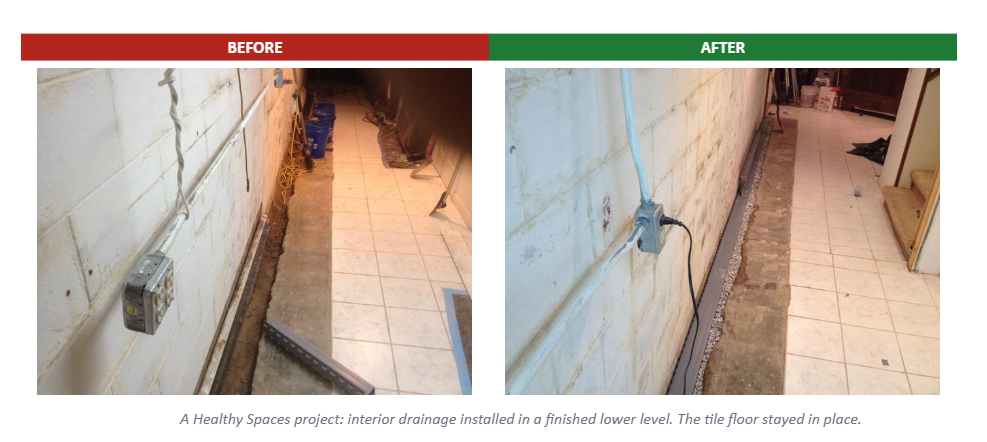
A drain line is installed underneath the basement floor, just inside the foundation walls, at the wall-floor joint where the majority of water enters. Water collected by that channel travels to a sump pit, where a sump pump automatically moves it outside and away from the home.
A few reasons it tends to be the right answer here:
- It is installed below the slab, so it is not visible when the work is finished
- It is not prone to the clogging that affects exterior drains
- It is reliable and straightforward to service if it ever needs attention
- Installation does not require excavating the yard or removing landscaping
- It addresses hydrostatic pressure at the point where water actually gets in
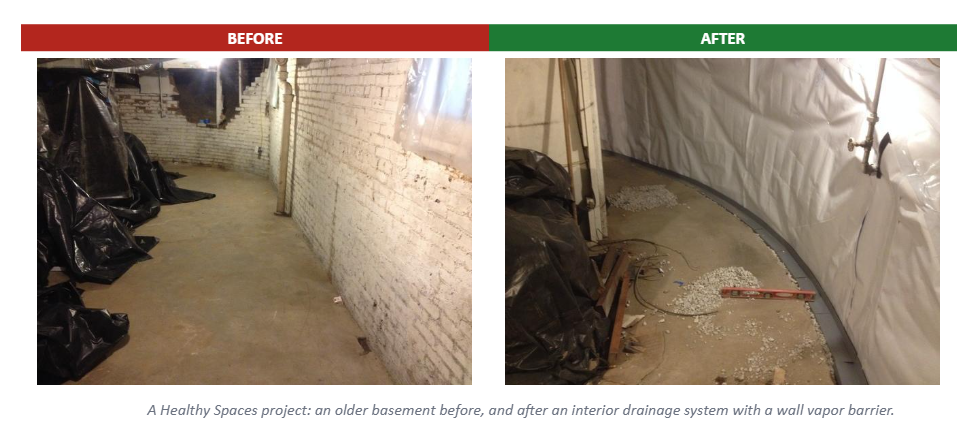
Method Three: Interior Baseboard System
A hollow plastic baseboard is installed along the base of the basement walls, forming a drainage channel above the floor that directs water to a sump pump system.
This is not a compromise so much as a solution for a specific situation. It is sometimes recommended when a basement slab is too thin to accommodate a subfloor drain, which does happen in older homes and in certain construction types.
It sits above the floor rather than below it, so it is visible. But in a basement where the slab will not support the preferred method, it provides a working drainage path that a sealant never could.
Method Four: Negative-Side Sealant
This technique involves painting the basement walls and floors with a waterproof, cement-based coating intended to seal moisture out. It is widely available, inexpensive, and frequently attempted by homeowners before calling anyone.
Here is the difficulty. Even when applied correctly, that thin membrane is being asked to hold back hydrostatic pressure — the force of water-saturated soil pressing against the outside of the foundation. In our region, where clay-heavy soil holds water against foundation walls for days after heavy rain, that pressure is considerable and it is persistent.
Under prolonged pressure, these coatings usually fail. The water does not stop; it finds the edge of the coating, a seam, or works through the material. Many of the basements we are called to have a sealant coating already on the walls, applied by a previous owner who believed the problem had been solved.
How the Right Method Gets Chosen
The honest answer is that it depends on what a specific basement is doing, which is why a real assessment matters more than a general recommendation. During an inspection, a System Design Specialist evaluates:
- Where water is entering — the wall-floor joint, cracks, windows, or several points
- The thickness and condition of the basement slab
- Existing drainage, grading, and how water moves across the property
- Whether the space is finished, and what would be disturbed
- Groundwater volume and whether a sump system needs additional capacity
- Prior repairs, including sealants or systems that have already failed
What Homeowners Can Do Before Calling Anyone
Note when the water appears. Water after heavy rain suggests a different cause than water that shows up seasonally or without any storm at all.
Find where it starts. Follow the dampness to its highest point on the wall. Water at the wall-floor joint tells a different story than water running from a window well.
Take photos during a wet period. A dry basement in September does not tell a contractor much. Photos from the last time it was wet tell them a great deal.
Be skeptical of a single recommendation. A company that installs only one solution will recommend that solution. Ask why it fits your basement specifically.
Ask what happens to the water. Any legitimate system has an answer for where collected water goes and how it leaves the property.
Why the System Behind It Matters
Healthy Spaces installs products developed, patented, and refined by Basement Systems, Inc., the world's largest network of basement waterproofing contractors. Those products have been keeping basements dry in the United States, Canada, and the United Kingdom since 1987, and have been used in hundreds of thousands of basements and crawl spaces worldwide.
That matters less for the brand name than for what stands behind it: a warrantied system, technicians trained to install it correctly, and a method that has been tested across far more homes than any single contractor could see in a career.
Healthy Basement, Healthy Home
A dry basement is worth more than the square footage it recovers. It means lower humidity throughout the home, fewer conditions that support mold growth, and a space your family can actually use.
If your basement takes on water, smells damp, or has a coating on the walls that stopped working a few seasons ago, an inspection can identify where the water is entering and which approach fits your home.
Let's find out what your basement is actually doing. Schedule your free waterproofing estimate with Healthy Spaces — locally owned and keeping Tri-State basements dry since 1999.